The space I once loved, which fueled my creativity, felt more cluttered and stressful by the day. Maybe you know this feeling all too well. Read on because one small decision completely changed the way I looked at my craft stash, and it wasn’t the solution I expected.
How to declutter craft supplies and reclaim your creativity.
I’m standing in front of my craft cupboard, looking for one thing, only to have ribbons tumbling out, paper stacks sliding sideways, and half-finished projects piled in every drawer. What started as a creative outlet has slowly become a source of frustration, guilt, and overwhelm.
Knowing I should sort through it all, but feeling as though every item seems tied to a future project, happy memory, or money already spent. So the supplies keep piling up, while the space I once loved, which fueled my creativity, feels more cluttered and stressful by the day. Until one small decision completely changed the way I looked at my craft stash, and it wasn’t the solution I expected.
Five Reasons you have too many craft supplies (and how to fix it)
At some point, most crafters experience common emotions when it comes time to declutter their craft supplies. Overwhelm, guilt, attachment to supplies, and the “I’ll use it someday” mindset. Over the years, I’ve kept so many items thinking I will use them one day, only to end up throwing them away or donating them. Holding onto those items meant they took up valuable space and added to the clutter.
It is so easy for a creative hobby to morph into a full-blown storage crisis. Crafters like myself don’t just buy materials; they buy potential, inspiration, and future time, which makes parting with a single ball of yarn, scraps of fabric or piles of craft paper surprisingly emotional.
Here are the 5 most common psychological hurdles crafters like myself face when they find themselves drowning in craft supplies and seemingly unable to let go. Let’s dive into those struggles and the actionable strategies you can use to fix your clutter problem.
The Sunk Cost Fallacy
One of the biggest reasons decluttering your craft supplies feels so difficult is what psychologists call the ‘sunk cost fallacy’. Simply put, we struggle to let go of things because we focus on the money we’ve already spent on them. I know this feeling all too well.
Previously, I started a new hobby that required a lot of expensive tools and specialty materials. For a while, I was completely engrossed in my new craft. But life changes, and I could no longer invest the amount of time the hobby required. I will admit I went overboard in the amount of supplies I purchased, enough to complete a further 10 projects. Those supplies sat year after year, taking up space in my craft cupboard, but I couldn’t part with them. Thinking about just how much money I had spent kept me stuck.
The reason I kept those craft supplies was because of their cost, even though I was no longer passionate about the hobby. The truth is, the money had already been spent whether I kept the supplies or not. Instead of bringing me joy, those supplies made me feel guilty every time I saw them. Not only the money spent, but also the sadness of not finishing the projects that I was so excited to complete.
Many crafters experience this same struggle. Holding onto expensive tools, specialty materials and forgotten project kits because discarding them feels wasteful. In reality, keeping those supplies allows clutter to occupy valuable space in your home and mind. It’s important to give yourself permission to let those items go and stop paying for past purchasing decisions with today’s storage space.
Shift your Mindset…
When you’re faced with a cupboard full of expensive stamping kits or high-end paints, and feeling intense guilt over the money spent. Passing them on feels like admitting defeat or “wasting” cash. Instead, shift your mindset from retail value to storage cost. Remind yourself that the money is already gone, and keeping the item won’t bring it back. Right now, that unused supply is actively taxing your mental peace and physical space.
Donating your over supply of craft items to local schools, daycare centres, senior centres, or community groups can be incredibly rewarding. Knowing that your supplies are going to people who will genuinely appreciate and use them can make it easier to let go.
The Identity Crisis – Letting go of your fantasy self.
Sometimes the hardest part of trying to declutter your craft supplies has nothing to do with the supplies themselves. Instead, it involves letting go of the person you hoped to become. Many of us collect materials for hobbies we dream about pursuing one day. We buy watercolours because we imagine ourselves painting beautiful landscapes. We purchase sewing supplies because we picture ourselves making handmade clothes.
After being inspired by a talented artist online who made beautifully detailed miniature dioramas, I decided to dive straight into that hobby. I loved the idea of becoming someone who created similar handmade pieces, but the truth was that I hadn’t touched those supplies in years. Letting them go felt like giving up on part of my identity. This emotional attachment often creates an internal conflict between who we are today and who we wish we could be.
As a result, the supplies remain untouched while clutter continues to grow. Eventually, I came to realise that I admired the beautifully crafted pieces that other people created more than engaging in the hobby myself. I was then able to let the items go to someone who would use and enjoy them. Separating your current reality from your fantasy self will help you to successfully declutter those craft supplies. Your home deserves space for the activities you genuinely enjoy, not just the hobbies you once imagined pursuing.
The Two-Year-Rule…
Struggling to release craft supplies, try The Two-Year-Rule. If you haven’t touched a specific craft category in two years, that season of your creative life has closed, and that is okay. Freeing up that space allows you to focus deeply on the crafts you actually enjoy today, rather than feeling guilty about the ones you don’t. Still not sure, set yourself a specific amount of time, say 3 months, to actively start that craft or hobby again. By then, if you still haven’t made time after that, then you most likely never will. If you truly enjoy something, you will find the time.
Fear of Future Scarcity – What if I need it someday?
The fear of future scarcity keeps many people from successfully decluttering their homes, including craft supplies, even when they haven’t used those items for years. This fear usually presents like a simple question: “What if I need it someday?” The possibility of future need often feels more powerful than the reality of present clutter. Our minds can come up with a thousand reasons why you should keep something if you let it.
I’ve held onto items thinking I will use them one day. Years passed, and those items remained untouched while they consumed valuable storage space. Yet every time I considered donating them, my mind immediately imagined the one project that would require that exact item, and what if I had just discarded it?
This thought pattern feels incredibly common among crafters because creativity often involves possibilities and future ideas. Unfortunately, keeping everything “just in case” creates overcrowded craft spaces that become difficult to use and enjoy. The stress and frustration caused by excess clutter, however, affect you every day. When you declutter your craft supplies, you choose to prioritise your current needs instead of allowing hypothetical future projects to control your space.
The Leftovers Box…
It’s safe to say that we can easily replace most items if we genuinely require them in the future, but most often, we never end up needing them. And the truth is, a lot of craft supplies and materials lose their quality if kept for too long. Stickers lose their stickiness, paints spoil, embellishments age and papers become damaged.
If saving every micro-scrap of ribbon, paper offcuts, or random buttons sounds like you (myself included) because “it might be perfect for a project someday try using physical limits.
Establish a ‘Leftovers Box’. Give scraps a strict physical limit like a single mason jar or a small container. Once that container is full, you have to use something before adding anything new. If you really need to keep something, you will need to release something else to do so.
Analysis Paralysis and Visual Overwhelm.
I can’t count how many times I’ve decided it was time to declutter my craft supplies, just to stand there feeling completely frozen the moment I open a cupboard or enter my craft room. This reaction often stems from analysis paralysis caused by visual overwhelm and too many decisions to make. When you face hundreds of supplies, unfinished projects, containers, tools, papers, fabrics, and embellishments all at once, your brain struggles to decide where to start.
Opening my craft cupboard one afternoon, I had every intention of decluttering my craft supplies. But within minutes, I felt overwhelmed by the sheer volume of decisions I had to make. Should I sort the paper first? Organise the stamps? Finish old projects? Donate supplies? The number of decisions felt exhausting before I had even started. As a result, I closed the cupboard door and walked away. Many crafters experience this exact scenario.
The clutter becomes so visually noisy that it drains mental energy and creates avoidance. Instead of inspiring creativity, the space triggers stress and indecision. When you declutter your craft supplies gradually and focus on one small category at a time, you reduce visual overwhelm and make decision-making far easier. Small wins create momentum, while trying to tackle everything at once often leads to frustration and procrastination.
Declutter your craft supplies by category…
Cramming stuff into drawers and numerous containers makes it hard to keep track of what you own. It’s difficult to sit down and create when the mess is draining your energy. A cluttered and unorganised environment isn’t conducive to the space required to pursue your craft or hobby. It can cause you to end up abandoning the project before even beginning.
Declutter by category, not by drawer or container. Gather all the paint, all the fabric, or all the embellishments into one central pile. Seeing the sheer volume of one specific item makes it much easier to spot duplicates, dried-out supplies, and low-quality materials that can be purged immediately. Tackle one category at a time to avoid decision overwhelm. Do what you can for the day and come back to the rest later.
In-Progress Project Stagnation.
One of the most emotional reasons I’ve faced when struggling to declutter my craft supplies involves unfinished projects. These half-completed creations often represent good intentions, excitement, and creative dreams that never quite reached the finish line. Every unfinished project carries a story, which makes it difficult to let go.
When I was pregnant with my first child, I started a long-stitch needlepoint project for the nursery that I never managed to finish. My son arrived prematurely, and then life and motherhood took over. I held onto that project for years, even carting it from house to house when we moved, always with the intention to complete it. Even though my son had long left the nursery behind, the memories remained, and I still felt I needed to finish the project. I told myself I would get around to it someday, yet the years continued to pass without me returning to it.
Many crafters experience this same form of project stagnation. Unfinished work creates emotional clutter as well as physical clutter because each project silently reminds you of something left undone. Instead of feeling inspired, you feel burdened by an ever-growing list of creative obligations. The truth is that not every project deserves a permanent place in your home. Like my long-stitch needle-point project, the time had passed, and I needed to let it go and look to the future. When you declutter your craft supplies and release projects that no longer excite you, you free yourself from guilt and create space for the creative activities that truly bring you joy today.
The Honesty Audit…
You don’t need to continue to hold onto dozens of unfinished projects purely because of the amount of hours of work you’ve put into them. If you find that you have lost interest in those projects, its ok to let them go, even if you never finished them.
Think of it not as time wasted or incomplete work, but instead recognise it as something you learned and enjoyed at that moment of your life.
The Honesty Audit. Gather all your unfinished projects and look at each and ask: “If I had the free time right now, would I actually enjoy working on this?” If the answer is no, acknowledge your hard work, take a photo to keep if needed and let it go.
Step by Step – How to declutter craft supplies this weekend.
Here are a few quick tips to get you started decluttering your craft and hobby supplies and go from chaos to creativity.
Ready to jump in and declutter your craft supplies?
Read more about these decluttering top tips to get you started on your journey to a clutter-free home.
The surprising solution I wasn’t expecting…
One small decision completely changed the way I looked at my craft stash, and it wasn’t the solution I expected. I’ve always been a ‘more is better’ kinda girl when it came to accumulating craft and hobby supplies. I always thought that having more paints, more embellishments, more yarn, basically more of everything, meant that I could do my chosen crafts better and could be more creative if I had more supplies.
Whilst going through my supplies for each of my crafts, I had a thought. Maybe less is more? What if I only kept the necessary items to complete each project and discarded the rest? What if I reduced my tools down to those I frequently used and donated the rest? Could having less supplies and materials create more time for creativity?
Yes, it did. Less supplies meant more time crafting and less time wasted looking for things. Less tools meant I could easily reach for exactly what I needed without sorting through all the things I kept ‘just in case’. And most surprisingly, reducing my craft supplies freed up my creativity and brought a sense of calm back to my craft space.
Less is more…
Now, when I craft, I purchase only the embellishments, paints or papers I need for that project. Lots of shiny new things always tempt me, but unless I have a specific project in mind to use them, they stay on the shelf in the store. Deciding to keep less supplies and materials has given me more time and space to pursue my creative endeavours.
Everything is organised and easy to find. I don’t have anything more than what I need for my current projects, making it so easy to grab my supplies and get straight into creating.
Happy creating, fellow crafters!

Create a beautifully organised home you love.


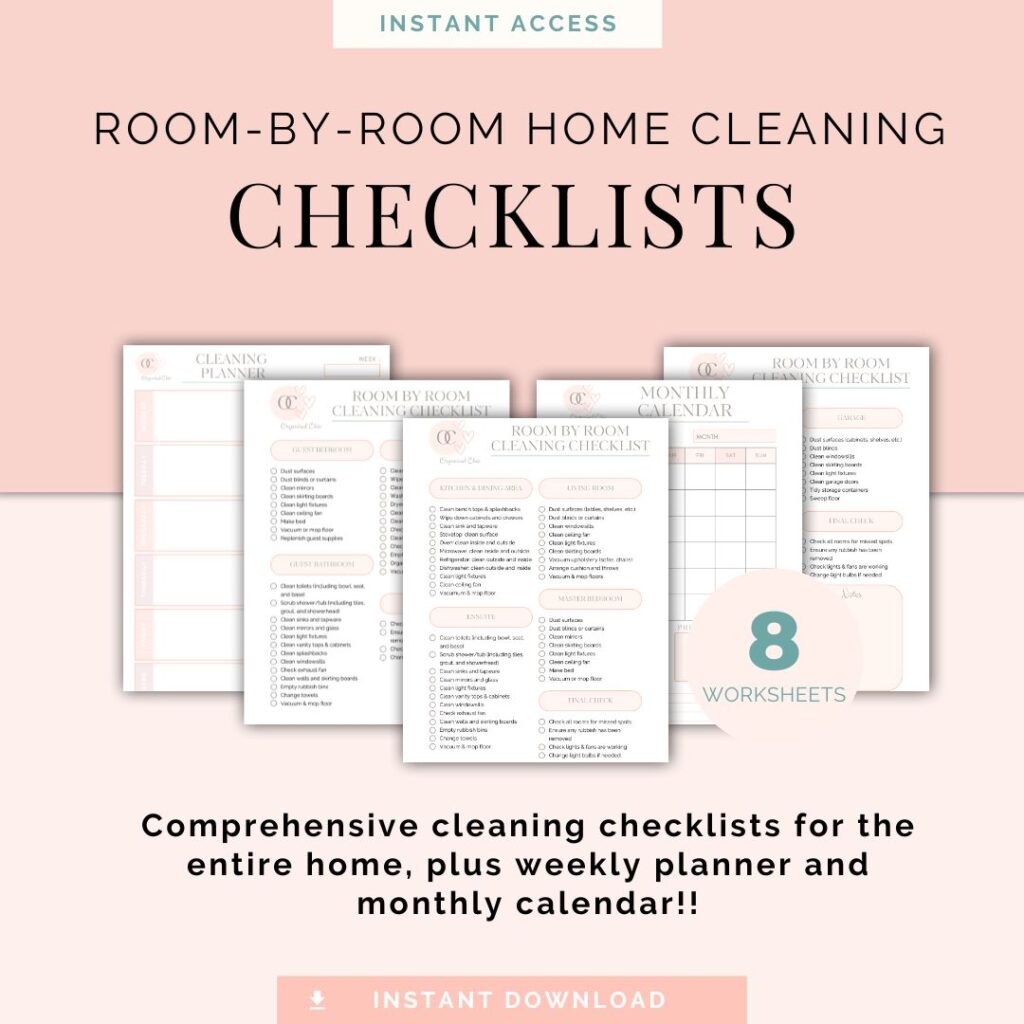
Need a checklist that covers every room of the house so you don’t miss a thing? Now you can tackle your cleaning tasks efficiently and with ease with my comprehensive Room-by-Room Whole House Cleaning Checklist.
You can find the checklists here. Print or upload the PDF to a notetaking App.
Instant access – Digital Download – Unlimited Use!