If you’re ready to stop drowning in paper, these simple, practical methods will help you regain control—fast.
Even in our increasingly digital world, there’s still plenty of paper that needs sorting, filing, and actioning.
Effective strategies for reducing paper clutter at home…
Reducing paper clutter was always something I struggled to control in my home. From school notes and kids’ artwork to catalogues, bills, and flyers, the paper just never stopped. Honestly, the amount of paper flowing in was absurd. Fortunately, today we are moving into a more digital-centric world. Even so, we still have paper items to sort, file, action and store. Here are some effective ways to manage household paper clutter in the home.
Every week, numerous free newspapers, magazines, advertising leaflets, business flyers and shopping catalogues are still being dropped onto our driveways and into our mailboxes. There is the option to display a ‘No Junk Mail’ notice in the hopes of keeping some of it at bay. And while some of us enjoy the read, that enjoyment can quickly turn into overwhelming piles on every surface. So, how do we manage the flow of paper materials without feeling like we are drowning under a sea of paper?
Paper clutter can accumulate fast, and before you know it, the kitchen bench or coffee table has disappeared beneath a mammoth pile of reading literature.
In order to deal with the volume of paper items, I have put together a few methods to sort your paper clutter. These tips certainly work for me in reducing the amount of paper that finds its way into my home.
Newspapers, catalogues and advertising materials…
When it comes to catalogues, free newspapers and magazines in the mailbox, I find this trick works best for me to keep all that junk mail under control. After I collect the junk mail, I go directly to our recycling bin. Here I can quickly scan and put aside anything I’m interested in reading. The rest doesn’t even make it into the house; it goes straight into recycling.
Containing the junk mail…
I then have a designated spot for junk mail and the likes, which in my house is the drawer beneath my coffee table. Find a designated spot in your home for all reading material, preferably a drawer or basket. Limit the size of the area that paper accumulates; this will force you to clean it out regularly to prevent it from overflowing. Try to keep places like the kitchen bench, dining table, office desk and hall table free of paper clutter.
The day before our fortnightly recycling collection day, I gather up everything that has been there at least a week and out it goes. Anyone in the house has one week to read the items before they join their friends in the recycling bin. If you haven’t read it by now, you’re not really interested.
Incoming mail and bills…
Handle incoming mail once. Make sure you have time to deal with the mail before you open it. Sometimes we quickly open the mail and flick through before dumping it somewhere like the hallway table or the kitchen bench. The papers then lie around waiting for you to decide their fate, with the potential for you to forget about them or lose them in the meantime.
Set aside time to go through the mail just as you do with your emails. Decide on each item before you move to the next. Place bills in your ‘bills to pay folder’ and mark the due date on your calendar as a reminder. All done in one step.
Is it an item that requires an action? Such as calling somebody. If so, try to attend to it straight away. If time doesn’t permit, note the item on tomorrow’s to-do list and place the letter in your ‘action required folder’. The paper item is now where you will be able to find it, and you have a reminder on your to-do list.
If the letter is purely informative, decide whether you need to keep it. Place items that you need to retain in the folder marked ‘Items to file’. Alternatively, file them immediately into the filing cabinet or archive box. Throw items straight into the recycling or place sensitive documents into the shredder, if you aren’t required to keep them. I like to keep my shredder in the office beside my desk, plugged in and ready to go. That way, I can shred sensitive information straight away, rather than leaving it to pile up.
Reducing paper clutter by going digital…
Finally, minimise paper clutter by switching to digital billing services and receiving electronic correspondence.
You can opt to receive your bank statements electronically and request information at any time. This means you don’t need to print these out or keep a paper copy. It’s easy to check your account activity online at any time.
You can receive most household bills via email or access them online through an account you set up with the company. Your account enables you to view all your account activity, bills due, and bills paid, as well as pay bills that are currently due.
I keep a list of which bills are due each month on a monthly budget sheet as a reminder to check emails for invoices. When you receive an electronic bill or invoice, be sure to jot down a reminder to pay on the calendar.
Children’s school papers and artwork…
Managing children’s school papers and artwork can feel like an emotional minefield as well as a clutter challenge. A good starting point is to create a simple “incoming” routine, one folder or tray where all school papers land as soon as they come home. Set aside a weekly time to go through it and sort items into three clear categories: action, keep, or recycle. Permission slips and notices get dealt with immediately, while worksheets, spelling tests, and routine notices can usually be recycled once reviewed.
For the papers you decide to keep, less really is more. Choose one clearly labelled folder or slim file per child for the school year and limit yourself to only the most meaningful pieces, think special achievements, progress milestones, or artwork that truly stands out. When the folder is full, it’s a sign to review and let go of older items. This built-in boundary helps prevent “just in case” papers from quietly multiplying.
Artwork can be the hardest to part with, so consider creating a memory system that doesn’t rely on keeping everything. Take photos of larger or less sentimental pieces and store them digitally, then keep only a small selection of favourites in a display frame or keepsake box. Involving your children in choosing what to keep can make the process easier and teach them valuable decision-making skills. The goal isn’t to erase the memories, it’s to preserve them without letting paper clutter take over your home.
“I create a calm, tidy home with ease. Everything has a place, and my space supports my peace, energy, and wellbeing.”
Quick list of tips for reducing paper clutter in your home…
Paper clutter doesn’t have to take over your home or your headspace. With a few simple systems in place and a more intentional approach to what you bring inside, it becomes much easier to stay on top of the paper flow before it turns into overwhelming piles.
Remember, progress matters more than perfection. Small, consistent habits will reduce paper clutter over time, free up valuable space, and make your home feel calmer and more organised—one sheet at a time.
Read more about how to declutter your home. Here you will find some great tips to get you started. Decluttering Top Tips to get you Started.

-
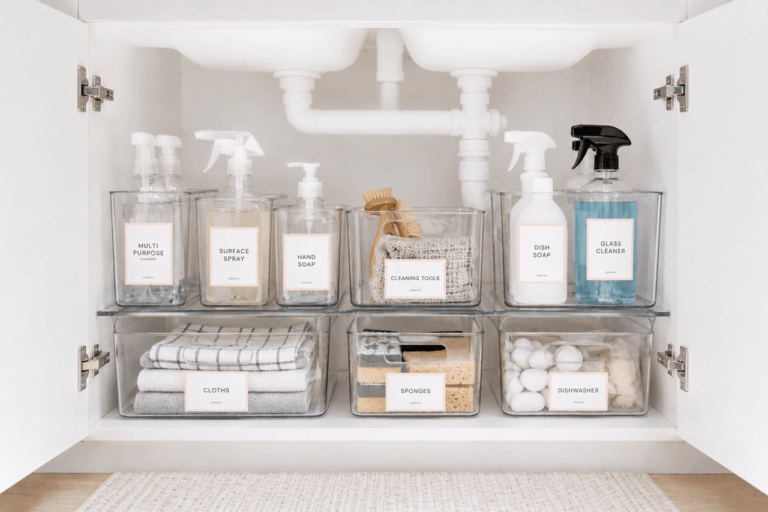
Organising under the kitchen sink in 30 mins made easy.
The cupboard under the kitchen sink is one of the most-used spaces in the home, yet it can be one of the hardest and most awkward spaces to organise. This small cupboard is quietly creating more stress than you realise, and fixing it is easier than you think.
-
Drowning in Craft Supplies? The reasons why and how to declutter.
The space I once loved, which fueled my creativity, felt more cluttered and stressful by the day. Maybe you know this feeling all too well. Read on because one small decision completely changed the way I looked at my craft stash, and it wasn’t the solution I expected.
-
26 Simplistic things to reclaim your peace this year.
These are the 26 simplistic things I’m focusing on this year to reclaim my peace, and how you can too. Gentle habits, intentional boundaries, and quiet choices that bring you back to yourself. Not by adding more but letting go of what no longer serves you.
-
The affordable essential items you need for your most organised year yet!
Start the year right with my top 5 affordable essential items you need for your most organised year yet! Simple yet highly effective everyday planning items for all aspects of home and life.
-
It’s Here! Your 10 Day Home Reset. A quick and simple plan.
A 10-Day Home Reset Plan. As I stood and looked around my home, I decided right then and there that I did not want to go into the new year feeling overwhelmed and frantic. I knew if my home felt calm, then I would feel the same. So, with 10 days left until the end […]
-
Cleaning oven racks using this unusual way. Hack tested and the results.
While searching the internet for a quicker way to clean my oven racks, I found an article suggesting the use of dryer sheets. I’m sure I am not alone when I say that cleaning the oven is one of my least favourite tasks. I’m always interested in quicker cleaning techniques, so I decided to put […]